

Researching a topic online can quickly become overwhelming. A simple question can lead to dozens of search results, research papers, PDFs and academic websites, leaving you with the difficult task of figuring out which sources are actually useful.
This is where Consensus AI takes a different approach.
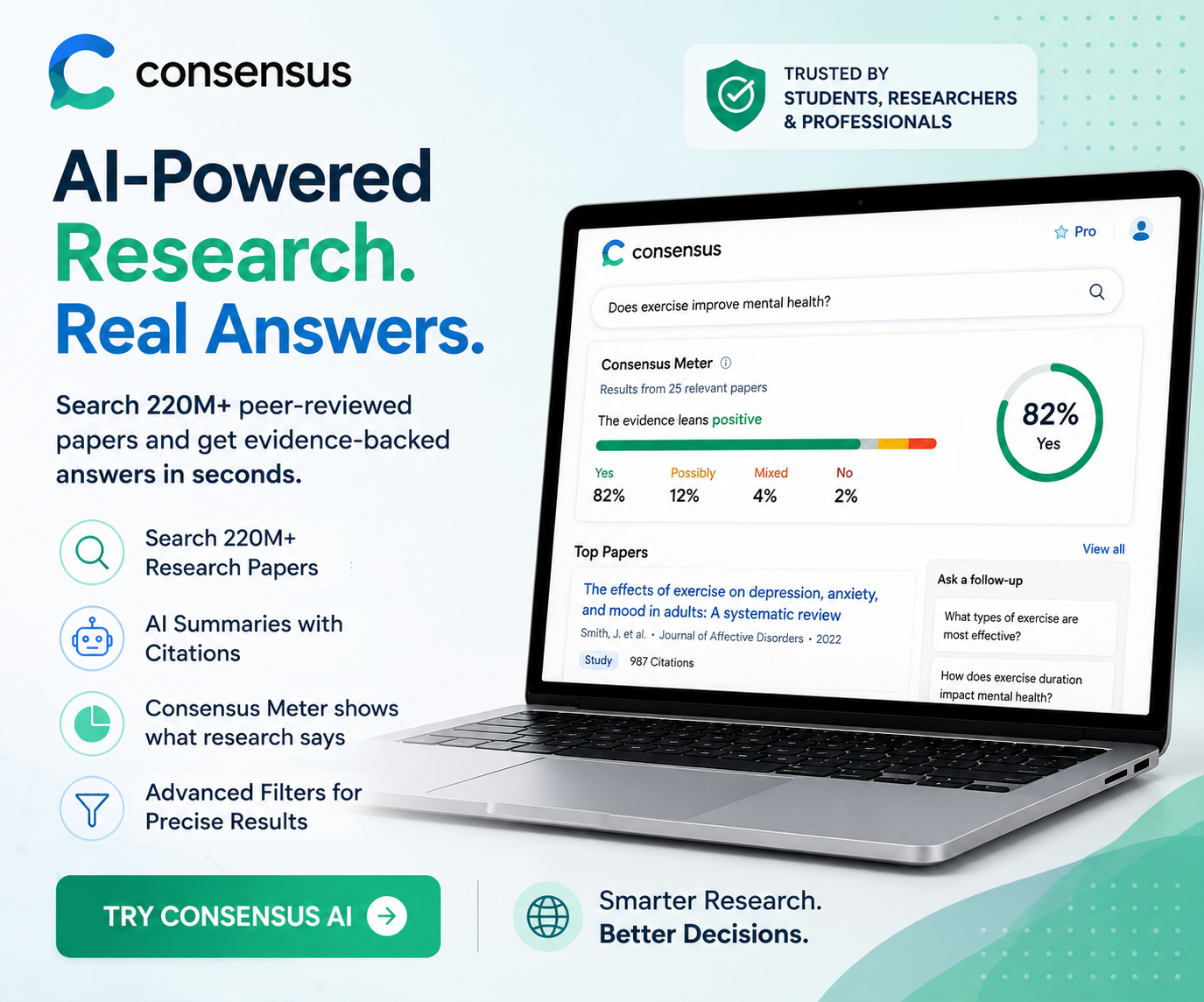
Consensus is an AI-powered academic search engine designed specifically for finding and understanding scientific research. According to Consensus, its database contains more than 220 million peer-reviewed research papers, covering areas ranging from medicine and biology to psychology, technology and social sciences.
Instead of simply generating an answer, Consensus searches academic literature first and then uses AI to summarize the research it finds. That makes it particularly useful for students, researchers, professionals and anyone who wants evidence-backed information.
What Is Consensus AI?
Consensus is essentially an AI research search engine built around academic literature.
Rather than asking an AI chatbot to generate an answer from scratch, you can ask Consensus a research question such as:
“Does regular exercise improve sleep quality?”
Consensus searches its research database for relevant studies and presents the findings in a way that is easier to understand.
The platform combines semantic search with traditional keyword search to identify relevant papers. Its database is sourced from platforms and scholarly sources including Semantic Scholar, OpenAlex and Consensus’ own scholarly-web crawl.
The important difference is that the answers are connected to the underlying research papers, allowing users to investigate the original sources instead of relying only on an AI-generated response.
How Does Consensus Work?
Using Consensus is relatively straightforward.
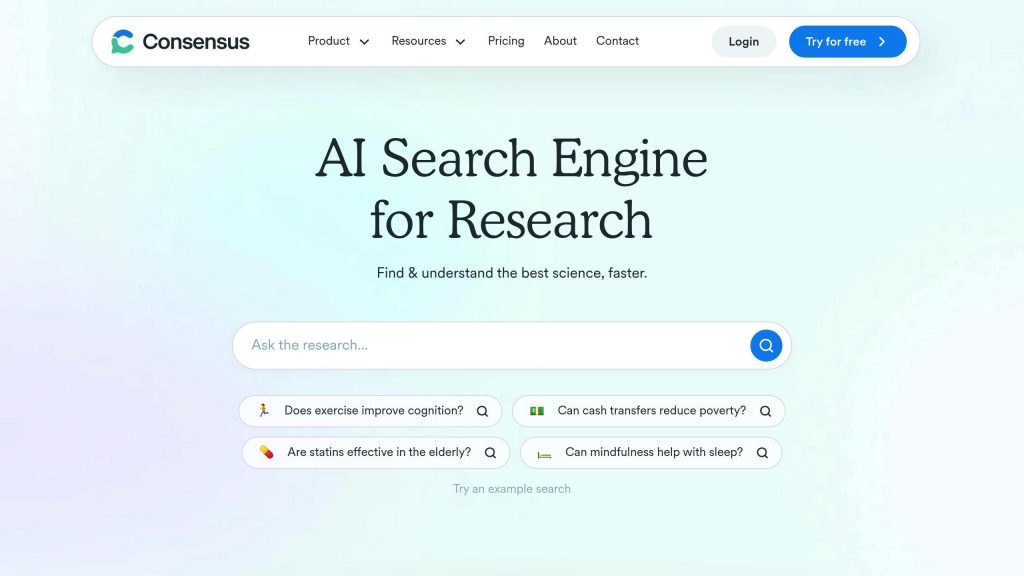
You start by entering a research question, topic or specific paper into the search bar. You can use normal keywords, natural-language questions or even more detailed instructions.
Consensus then searches its research database and identifies relevant papers. Depending on the search mode you use, the platform can analyze multiple papers and provide a synthesized answer with citations.
For example, instead of searching Google for:
“benefits of intermittent fasting research papers”
you could ask:
“Does intermittent fasting help with weight loss in adults?”
This type of question gives the system a clearer research objective.
Consensus currently offers different research workflows, including Paper Search, Pro and Deep modes. Paper Search is useful when you simply want to browse relevant papers, while Pro and Deep are designed for more detailed analysis.
Key Features of Consensus AI
1. AI-Powered Research Search
The biggest advantage of Consensus is its focus on academic research.
The platform searches across more than 220 million research papers and uses both semantic and keyword-based search to find relevant studies.
This can save considerable time when you are starting a literature review or trying to understand a new subject.
2. Research Agent
Consensus also includes a Research Agent for more complicated research tasks.
Instead of running several searches manually, Research Agent can plan multi-step searches, apply filters and work across multiple research tools. It can assist with tasks such as finding similar papers, citation crawling, author searches, DOI lookups, study comparisons and research-gap analysis.
This is especially useful when a simple search is not enough and you need to explore a topic from several angles.
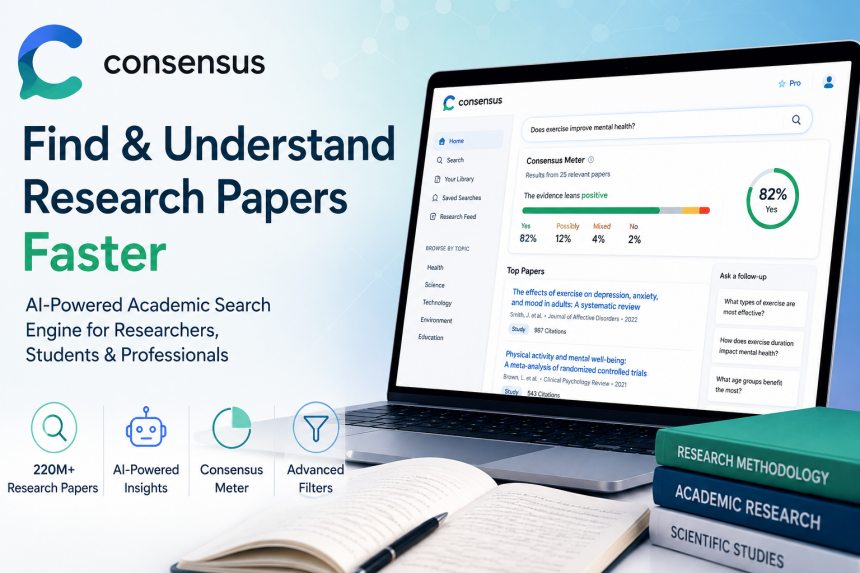
3. Consensus Meter
One of the more interesting features is the Consensus Meter.
Research papers do not always agree with each other. Some studies may support a particular conclusion while others produce different results.
Consensus Meter is designed to analyze the research surrounding yes-or-no questions and visualize the level of agreement or disagreement within the literature.
It can therefore provide a quick overview before you start reading individual studies in detail.
4. Study Snapshot
Reading an entire research paper just to understand its methodology, sample size or major outcomes can take time.
Consensus’ Study Snapshot is designed to extract important study information, helping users quickly understand the basic structure and findings of a paper.
This can be particularly helpful when you are comparing several studies.
5. Chat With Full Text
Consensus can also work with the full text of supported papers rather than relying exclusively on titles and abstracts.
Users can ask questions about specific papers, collections or uploaded documents and get answers based on the available research material.
For anyone doing serious research, this can make the process of going from “I found the paper” to “I actually understand the paper” much easier.
Who Should Use Consensus?
Consensus can be useful for several types of users.
Students can use it to discover academic papers for assignments, projects and dissertations.
Researchers can use it to explore existing literature, compare studies and identify potential research gaps.
Professionals can use it when they need to quickly understand research around a particular subject.
It can also be useful for people who simply want to separate research-based information from the huge amount of general content available online.
However, Consensus should not replace critical thinking or reading the original research. AI-generated summaries can help you understand a paper faster, but important conclusions should still be checked against the underlying study.
Is Consensus Better Than a Normal Search Engine?
It depends on what you are searching for.
Google is excellent for finding websites, news, tutorials, products and general information. Google Scholar is useful for discovering academic literature.
Consensus takes a more specialized approach by combining academic search with AI-powered research analysis.
Its main advantage is convenience: instead of opening multiple papers and manually trying to understand what they say, you can use Consensus to identify relevant studies and get a research-grounded overview first.
That does not mean every AI summary should automatically be treated as the final answer. The quality of the underlying studies still matters, and Consensus itself recommends evaluating the research rather than blindly accepting an AI-generated conclusion.
How to Try Consensus AI
If you frequently work with research papers, academic projects or evidence-based information, Consensus is worth exploring.
You can start with a simple question and then use filters or deeper research modes as your requirements become more specific.
Ready to explore Consensus?
Disclosure: This article contains a promotional link. If you sign up or take an action through the link, TechTalkCounty may receive compensation at no additional cost to you.
Final Verdict
Consensus is an interesting example of how AI can make academic research more accessible.
Its biggest strength is not simply that it uses AI. The real value comes from combining AI with a large academic research database and connecting generated insights back to research papers.
Features such as Research Agent, advanced search filters, Consensus Meter, Study Snapshot and full-text conversations can make the research process more efficient.
For students, researchers and professionals who regularly spend hours searching through academic literature, Consensus can be a useful addition to their research workflow.
The best approach is to use it as a research assistant rather than a replacement for research itself: use AI to discover and understand the literature faster, then go back to the original papers when the details really matter.
Frequently Asked Questions
What is Consensus AI?
Consensus is an AI-powered academic search engine designed to help users find, understand and synthesize scientific research.
How many research papers does Consensus search?
Consensus currently states that its database contains more than 220 million peer-reviewed research papers.
Who can use Consensus?
Students, researchers, educators and professionals can use Consensus to explore academic literature and research findings.
Can Consensus summarize research papers?
Yes. Its AI features can summarize findings across research papers and provide citation-backed insights.
Is Consensus a replacement for reading research papers?
No. It is better viewed as a research assistant that helps discover and understand literature faster. Important findings should still be verified by checking the original research.